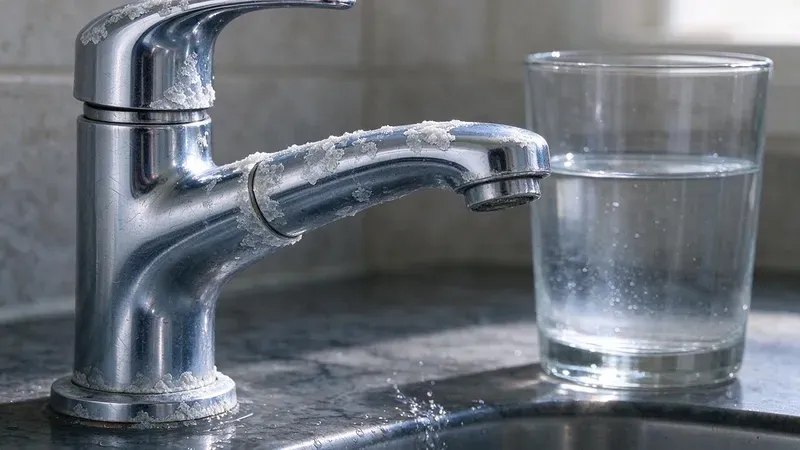
If you live in Arizona, you already know the look of hard water. Cloudy spots on glasses, white crust around faucet bases, and shower doors that never seem to come clean. Much of the state draws water from deep aquifers and from the Colorado River through the canal system, and both sources carry high levels of dissolved calcium and magnesium. Many Arizona water utilities report hardness well into the double digits in grains per gallon, which places the state among the hardest water regions in the country. The visible spots are a nuisance. The scale you cannot see is what costs money.
What Hard Water Does Inside Your Plumbing
When hard water is heated, the minerals drop out of solution and form a rock-like scale. That is why water heaters take the worst of it. In a tank heater, scale settles on the bottom and coats the elements, forcing the burner or elements to run longer to heat the same amount of water. You may hear popping or rumbling as water trapped under the sediment boils. In tankless heaters, scale builds on the heat exchanger and can trigger error codes and reduced flow within a year or two if the unit is not descaled.
Scale also narrows the inside of faucet cartridges, shower valves and aerators, which causes dripping, stiff handles and weak spray. Dishwashers and washing machines have valves and heating elements that suffer the same way. Toilet fill valves and flappers wear faster, and you may notice the bowl staining around the rim jets. Over many years, older galvanized steel lines can lose much of their diameter to mineral buildup combined with corrosion.
How a Water Softener Works
A conventional softener uses ion exchange. Water passes through a tank filled with resin beads that trade sodium or potassium ions for calcium and magnesium. When the resin is full, the control valve runs a regeneration cycle, rinsing the beads with brine from the salt tank and sending the captured minerals down the drain. Modern metered valves regenerate based on actual water use rather than a timer, which saves salt and water.
Salt-free conditioners, often called template assisted crystallization systems, work differently. They change minerals into microscopic crystals that are less likely to stick to surfaces, but they do not remove hardness. They require no salt and no drain, which appeals to some homeowners, though they will not eliminate spotting the way a true softener does.
When a Softener Pays for Itself
A properly sized softener installed by a plumber usually costs between $1,500 and $3,500, depending on capacity, valve quality and how much repiping the loop requires. Salt runs roughly $5 to $10 per bag, and a typical household uses a bag or two per month. Whether that investment pays off depends on your home. A softener tends to earn its keep when several of these apply:
- You have replaced a water heater, tank or tankless, earlier than its expected lifespan.
- You own a tankless water heater and want to protect the heat exchanger.
- Faucet cartridges, shower valves or toilet fill valves need replacing every few years.
- You spend real money on descaling products, spot rinse aids and glass cleaners.
- You plan to stay in the home for five years or longer.
- Your utility reports hardness above roughly 10 grains per gallon.
For many Arizona households, extending the life of a water heater by several years and cutting fixture repairs is enough to cover the cost of a softener over its working life, which is often 10 to 15 years for the tank and resin.
Getting the Details Right
Sizing matters. An undersized unit regenerates too often and wastes salt, while an oversized unit can let resin sit too long. A plumber should test your water hardness, count the people in the home, and check your peak flow rate before recommending a size. Most installers loop the softener so outdoor hose bibs and irrigation stay on hard water, since there is no reason to soften water for plants. Many homeowners also add a reverse osmosis system at the kitchen sink for drinking and cooking water, which removes the added sodium along with other dissolved solids.
When to Call a Professional
If your water heater is rumbling, your tankless unit is throwing scale codes or your fixtures are wearing out early, it is time to look at softening. CVR Plumbing tests water hardness, recommends a properly sized softener or conditioner, and installs the plumbing loop, bypass valve and drain connection to code. Call (928) 470-9009 to schedule a water quality visit and get a straight answer on whether a softener makes sense for your home.
Need a licensed plumber in Arizona?
CVR Plumbing answers 24/7 and offers same-day service across Arizona.