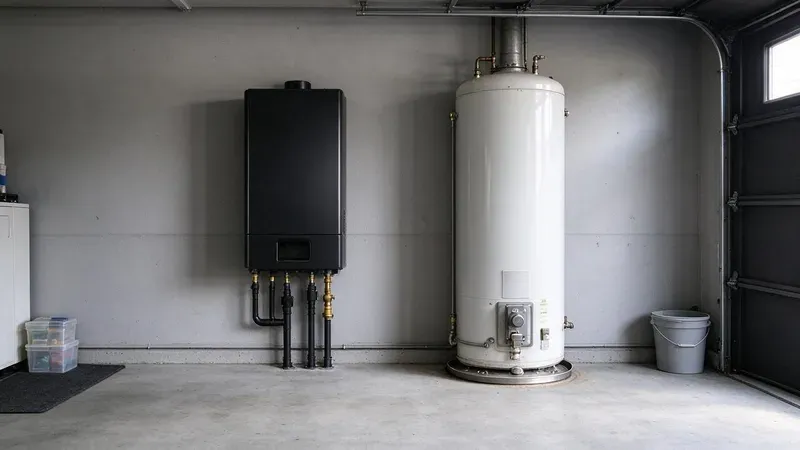
When a water heater fails, most Arizona homeowners face the same question. Should you replace it with another tank or switch to tankless? National buying guides rarely account for the conditions here. Incoming water temperatures run much warmer than in colder climates, garages can top 110 degrees in summer, and mineral-heavy water attacks every type of heater. Each of those factors shifts the decision in ways worth understanding before you buy.
How Each Type Works
A traditional tank heater stores 40 to 75 gallons of water and keeps it hot around the clock with a gas burner or electric elements. It is simple, familiar and relatively inexpensive to install. The tradeoff is standby loss, the energy used to reheat stored water that is sitting unused, and a finite supply. Once the tank is drained by back-to-back showers, you wait for it to recover.
A tankless heater heats water only when a fixture calls for it. Water flows through a heat exchanger, a flow sensor fires the burner, and hot water comes out as long as the tap is open. Capacity is measured in gallons per minute at a given temperature rise rather than tank size. Most whole-home units are gas-fired, since electric tankless models for a full house often require more amperage than an average panel can spare.
Why Arizona Changes the Math
Tankless capacity depends on how much the heater has to raise the water temperature. In much of the low desert, cold water entering the house during summer is already quite warm, and even in winter it stays milder than in many parts of the country. A smaller temperature rise means a tankless unit can deliver a higher flow rate, so one unit can comfortably serve more fixtures at once. In the high country around Flagstaff, colder incoming water makes proper sizing more important.
Hot garages also matter. A tank heater sitting in a 115 degree garage loses less heat to standby, which narrows the efficiency advantage of tankless during summer. On the other hand, those same conditions make hybrid heat pump water heaters work extremely well, since they pull heat from warm surrounding air and can cool the garage slightly as a bonus.
Hard water is the biggest Arizona-specific concern. Scale builds quickly on tankless heat exchangers, and most manufacturers require annual descaling to keep the warranty valid. Tank heaters suffer too, with sediment buildup shortening their life. Either way, a water softener or scale inhibitor ahead of the heater pays dividends here.
Comparing the Costs
Prices vary with fuel type, venting and code upgrades, but these ranges are typical for installed equipment in Arizona:
- Standard gas or electric tank, 40 to 50 gallons: about $1,400 to $2,800 installed.
- Gas tankless, whole home: about $3,000 to $6,000 installed, higher if the gas line must be upsized.
- Hybrid heat pump tank: about $2,800 to $5,000 installed, sometimes offset by utility rebates or federal tax credits.
- Annual tankless descaling: about $150 to $300 if done by a plumber.
- Tank flush: about $100 to $200, recommended once a year in hard water areas.
The hidden cost with tankless is often the gas line. A whole-home unit can draw 180,000 BTU or more, and many existing lines sized for a 40,000 BTU tank are too small. Converting from a tank to tankless also usually means new stainless or PVC venting, a condensate drain for condensing models, and an electrical outlet for the control board.
Which One Should You Choose?
A tank heater still makes sense for budget-focused replacements, rental properties and homes where the existing gas line and venting are not suited to tankless. Tankless is a strong fit for larger families who run out of hot water, homeowners planning to stay long term, and anyone who wants to free up garage space. A hybrid heat pump is worth serious consideration for electric homes with a garage install, since Arizona heat gives it ideal operating conditions. Expect a quality tank to last 8 to 12 years in hard water and a well-maintained tankless unit to last 15 to 20.
When to Call a Professional
Water heater installation involves gas piping, venting, combustion air, expansion tanks and temperature and pressure relief lines, all of which have to meet code. CVR Plumbing sizes tank, tankless and hybrid heaters based on your fixture count and incoming water temperature, checks gas line capacity, and handles permits where required. Call (928) 470-9009 for an honest comparison and an upfront quote on the right heater for your home.
Need a licensed plumber in Arizona?
CVR Plumbing answers 24/7 and offers same-day service across Arizona.